Our complete vision systems for industry
Our complete vision systems for industry
Vision systems are today one of the key tools for automating quality control and production process supervision. Despite their growing popularity, the concept of “vision system” is often simplified and reduced to individual elements — camera, software or algorithm.
In practice The vision system is a complex, integrated solution, the effectiveness of which depends on the correct design and commissioning of the entire architecture — from the measuring station to the communication with the production line.
What is an industrial vision system?
A vision system in industrial terms is a system that:
- acquires an image of the product under controlled conditions,
- processes it in real time,
- analyse the characteristics relevant to the quality or process,
- generates an unambiguous decision result,
- transmits this result directly to the production control system.
The key is that the vision system does not stop with image analysis.
Architecture of the complete video system
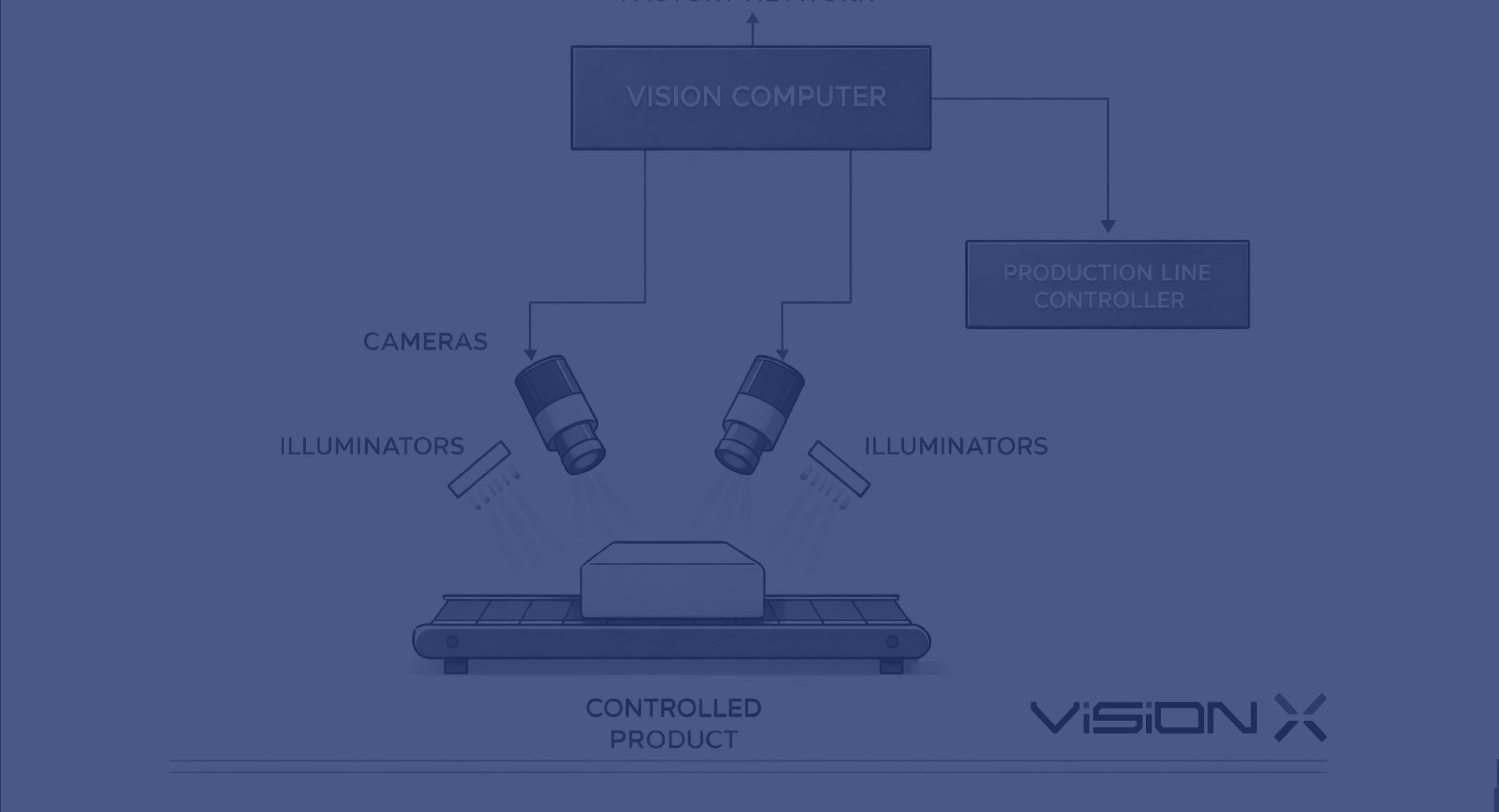
In the infographic we present our typical basic structure of an industrial video system, designed to work directly on the production line.
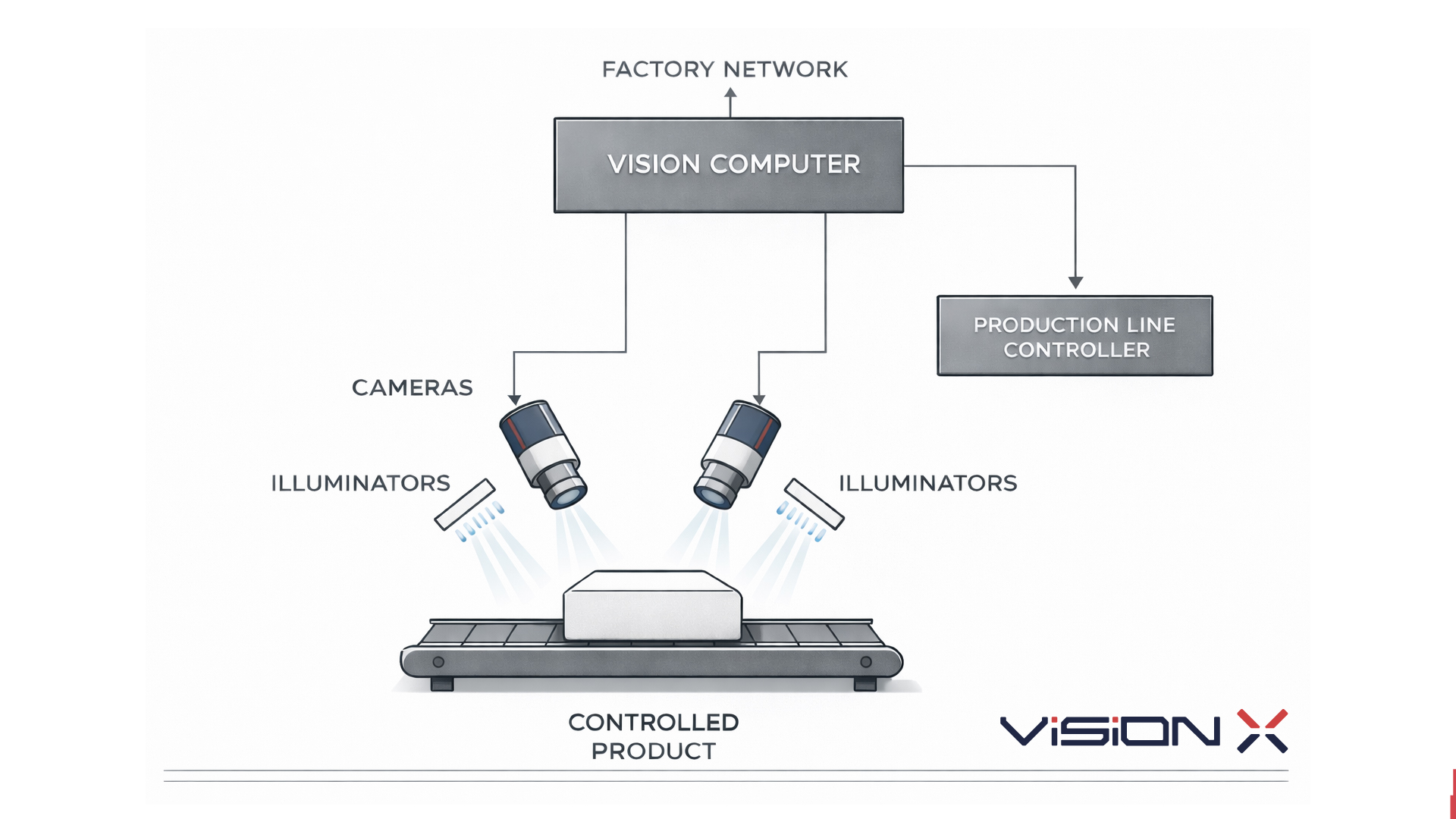
Product and process conditions
The starting point is always the actual product and the conditions in which it moves in the process:
- line speed,
- variability of position,
- vibration,
- soiling,
- variable ambient lighting.
The vision system must be designed with full consideration of these factors — not in laboratory conditions, but for production conditions.
Lighting — a critical element of the system
Lighting is one of the most important and at the same time most often underestimated elements of a vision system.
In a correctly designed solution:
- the type and geometry of lighting is selected for a specific feature of the product,
- the light is stable and repeatable,
- often several light sources operating in different configurations are used.
Without proper lighting, even the best camera and algorithm will not provide reliable results.
Cameras — a measuring element, not a solution in itself
Cameras in the vision system play the role of precise optical sensors. Their selection includes, among others:
- resolution and speed,
- the characteristics of the matrix,
- way to synchronize with lighting.
However, it should be emphasized that The camera itself is not a video system. It is only one of its components.
Computer Vision and Analysis Algorithms
The central element of the architecture is the vision computer, responsible for:
- image acquisition and caching,
- data processing in real time,
- implementation of image analysis algorithms,
- decision logic (OK/NOK),
- archiving of results and diagnostic data.
It is at this level that the transition from image to technological information occurs.
Integration with the production line
The most important stage is integration of the video system into an existing production line.
Complete system:
- communicates directly with the line controller (PLC),
- provides clear decision signals,
- works at the required cycle times,
- It is synchronized with the production process.
It is only at this point that the vision system ceases to be a diagnostic tool, and becomes
An active part of the technological process.
Enterprise network and process data
The vision system can also function as a data source for host systems:
- quality reports,
- production statistics,
- analysis of trends and deviations,
- MES or SCADA systems.
Thanks to this, machine vision supports not only quality control, but also the optimization of the entire process.
We design, integrate and commission complete vision systems — from A to Z. We are responsible for the entire implementation process, up to the moment of stable and repeatable operation of the system in production conditions. We do not supply individual components, but ready-to-use solutions.
See other articles